cAMPNOMAD Cells are cell lines stably co-expressing tag-free GPCRs and cAMP Nomad Biosensor to monitor G-protein modulation by cAMP release. Each vial of cAMPNOMAD ADRB1 Receptor Cell Line contains U2OS cells stably expressing the following constructs:
Human β1-adrenoceptor with no tag with no tag
cAMP Nomad Biosensor (Green Fluorescence)
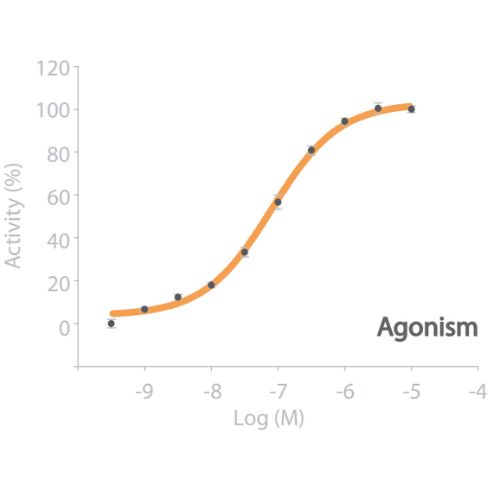
cAMPNOMAD ADRB1 Receptor Cell Line enables compound screening by analyzing G-Protein signalling pathway via cAMP following receptor activation. When an agonist binds to ADRB1 a G protein is activated which, in turn, triggers a cellular response mediated by cAMP. This leads to an increase of green fluorescence intensity of cAMP biosensor. This allows for quantification of receptor activity in living cells in a dose-response manner via fluorescence emission in a microplate reader.
The beta-1 adrenergic receptor (β1 adrenoreceptor), also known as ADRB1, is a cell membrane-spanning beta-adrenergic receptor. It interacts with (binds) epinephrine; a hormone and neurotransmitter (ligand synonym, adrenaline) whose signaling, via adenylate cyclase stimulation through trimeric Gs proteins, increases cAMP levels, and downstream effects such as increased heart rate and myocardial contractility. cAMPNOMAD ADRB1 Receptor Cell Line from Innoprot allows the measurement of the activity and potency of ligands; such as clenbuterol.
Green Fluorescent cAMP NOMAD Biosensor also expressed in the cell line, allows monitoring cAMP concentration changes when receptor is activated/inhibited.


 See more details on Bioz