ArresNOMAD Cells are cell lines stably co-expressing tag-free GPCRs and Arres NOMAD Biosensor to monitor G-protein modulation by receptor activation. Each vial of ArresNOMAD FSHR Cell Line contains HEK 293 cells stably expressing the following constructs:
Human Follicle stimulating hormone receptor (FSHR) with no tag
Arres Nomad Biosensor (Red Fluorescence)
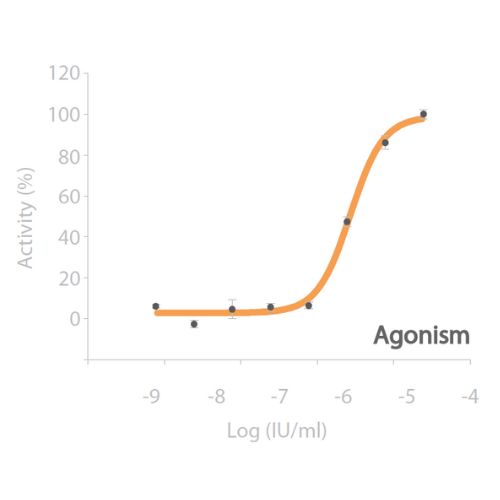
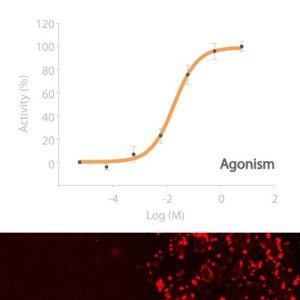
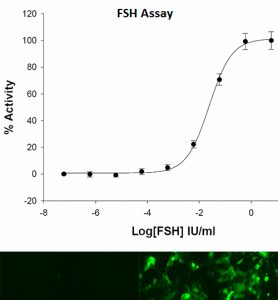
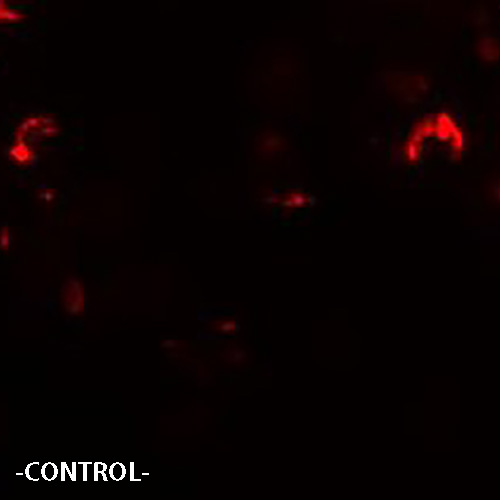
ArresNOMAD FSHR Cell Line allows for the assay of compounds analyzing the G-protein signaling pathway. When an agonist binds to FSHR, the Gs protein is activated, triggering a cellular response mediated by second messengers and subsequent arrestin recruitment. This result in an increase in the red fluorescence intensity of the Arrestin NOMAD biosensor. The activity can be easily quantified in living cells in a dose-response manner by fluorescence emission in a microplate reader.
The follicle stimulating hormone receptor (FSHR) is a G protein-coupled receptor (GPCR) that binds follicle-stimulating hormone (FSH). It plays a key role in reproductive physiology. It’s essential for the hormonal regulation of processes in the ovaries, testes and uterus. When an agonist binds to the receptor, a G protein is activated. This leads to a cellular response mediated by second messengers and a subsequent internalization mediated by β-arrestin. ArresNOMAD FSHR Cell Line from Innoprot enables the measurement of the activity and potency of FSHR ligands, such as FSH.
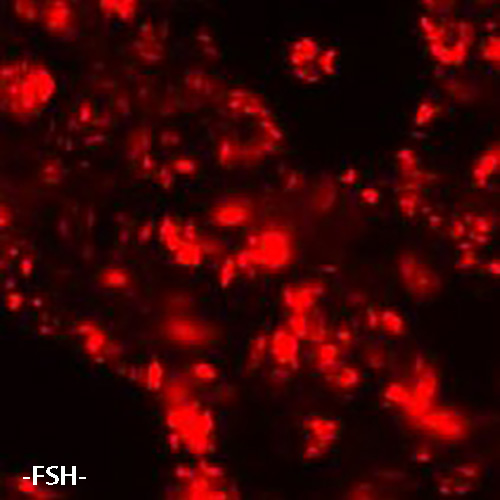
Red fluorescent Arrestin Nomad Biosensor is stably expressed in this cell line. It enables real-time visualization and quantification of β-arrestin recruitment in living cells.


 See more details on Bioz